
Introduction
Winning funding or securing a new business contract is a high-stakes endeavor. In today’s highly competitive landscape, your proposal must prove not just what you intend to do, but how you plan to measure success. A Monitoring & Evaluation framework serves as the backbone of your project’s accountability, yet it is frequently one of the most misunderstood and poorly executed sections of a proposal.
Whether you are an NGO responding to a donor’s grant application or pitching a new client, evaluators need to see a clear, logical, and actionable plan for tracking progress. Far too often, proposals fall short by including vague, unmeasurable objectives, over-complicating the methodology with jargon, or treating M&E as an afterthought rather than a core component of the project’s strategy.
When your M&E framework is weak, funders are left guessing whether your solution will actually deliver the promised results. By recognizing the most common M&E framework mistakes—and learning how to avoid them—you can build a compelling, data-driven narrative that proves your capability and secures the resources needed to drive your initiatives forward.
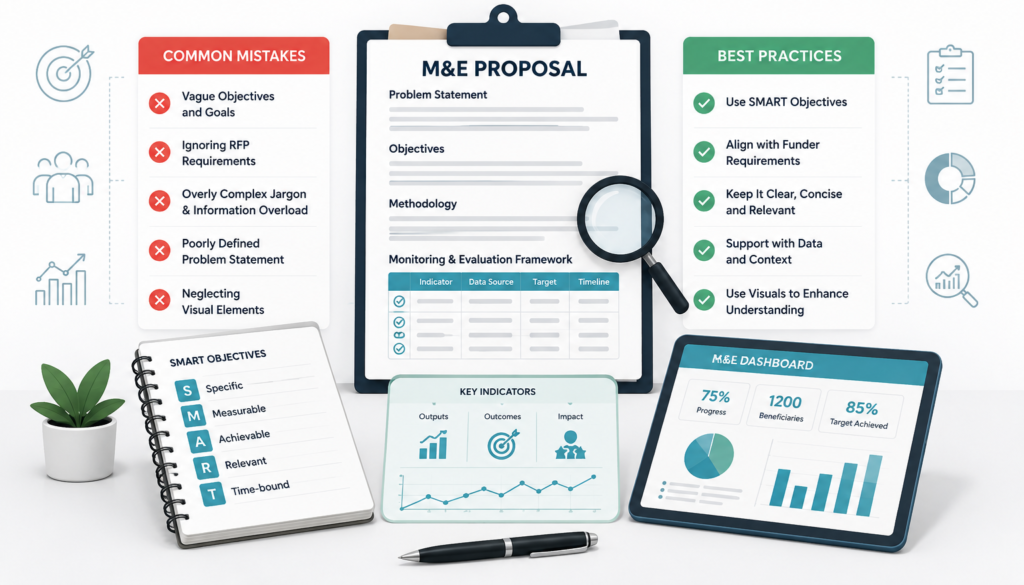
- Lack of Clear Objectives and Goals
- The Mistake: Proposals often contain vague objectives such as, ‘improve community health’ or ‘increase education outcomes’ without specifying exactly what will be achieved and when. Funders want to know the specific, measurable value your project will deliver. “When proposals lack specificity, they can come across as unfocused or vague, making it difficult for funders to understand the intended outcomes”.
- How to Avoid It: Use the SMART framework (Specific, Measurable, Achievable, Relevant, and Time-bound). Instead of a general goal, state a clear objective like: ‘Reduce the incidence of diabetes in the community by 20% over the next three years through targeted education and outreach programs.’ “This clarity helps clients understand the value you’re offering and sets clear expectations for the project.”
- Ignoring Solicitation or RFP Requirements
- The Mistake: Using generic, copy-and-paste templates without tailoring your approach to the specific funder’s criteria. This signals to evaluators that you have not taken the time to understand their distinct priorities.
- How to Avoid It: Thoroughly read the Request for Proposal (RFP), create a checklist of evaluation criteria, and tailor the language and methodology to align with the customer’s specific challenges and goals.
- Overly Complex Jargon and Information Overload
- The Mistake: Using long-winded language, overly complex technical terms, or dumping excessive, irrelevant information into the M&E section, which obscures your core value proposition. “Overly technical language or verbose content can obscure your message. Clarity and brevity are essential to convey your value proposition effectively.”
- How to Avoid It: Keep your writing clear, concise, and professional. Define technical terms when necessary, and use bullet points and clear headings to guide the evaluator through your methodology and M&E plan.
- Poorly Defined Problem Statement
- The Mistake: Failing to paint a vivid, data-backed picture of the problem you are trying to solve. If the problem lacks urgency, funders may question why the project is necessary.
- How to Avoid It: Support your problem statement with concrete data, context, and clear statistics rather than broad generalizations.
- Neglecting Visual Elements
- The Mistake: Submitting a proposal that is just a wall of text makes it difficult for evaluators to retain information.
- How to Avoid It: Incorporate visual aids such as charts, simple infographics, or flowcharts to illustrate key steps, timelines, and M&E indicators. Visuals significantly improve the reading comprehension and retention of evaluators.
Conclusion
Securing vital funding or a new contract is a high-stakes endeavor that requires proving exactly how you will measure success. A robust Monitoring & Evaluation framework acts as the cornerstone of your project’s accountability, yet it is often undermined by vague goals, excessive jargon, or a failure to tailor the content to the specific requirements of the funder. To stand out in a competitive landscape, you must replace generic templates with a bespoke approach that directly addresses the customer’s distinct priorities and challenges. By moving away from long-winded technical language and instead using the SMART framework to define your objectives, you provide evaluators with a clear and professional roadmap of the value you intend to deliver. Furthermore, supporting your problem statement with concrete data and using visual aids to break up dense text ensures your proposal is both persuasive and easy to digest. Ultimately, avoiding these common pitfalls allows you to build a logical, data-driven narrative that proves your capability and secures the essential resources required to move your initiatives forward.
About the Author
Charles Fahie is an IR and politics graduate with a master’s degree in Journalism and a second master’s degree in humanitarianism, aid and conflict. With roughly ten years experience in the Middle East, Charles focuses on political and social research and analysis in the region.
