Fraud and Corruption in Fragile Contexts: Understanding Risks and Recognizing Red Flags
Fraud and corruption present persistent risks to humanitarian action, particularly in fragile,
conflict-affected, or climate-vulnerable contexts. These environments are challenging due
to insecurity, political instability, and limited institutional capacity, but they also intensify
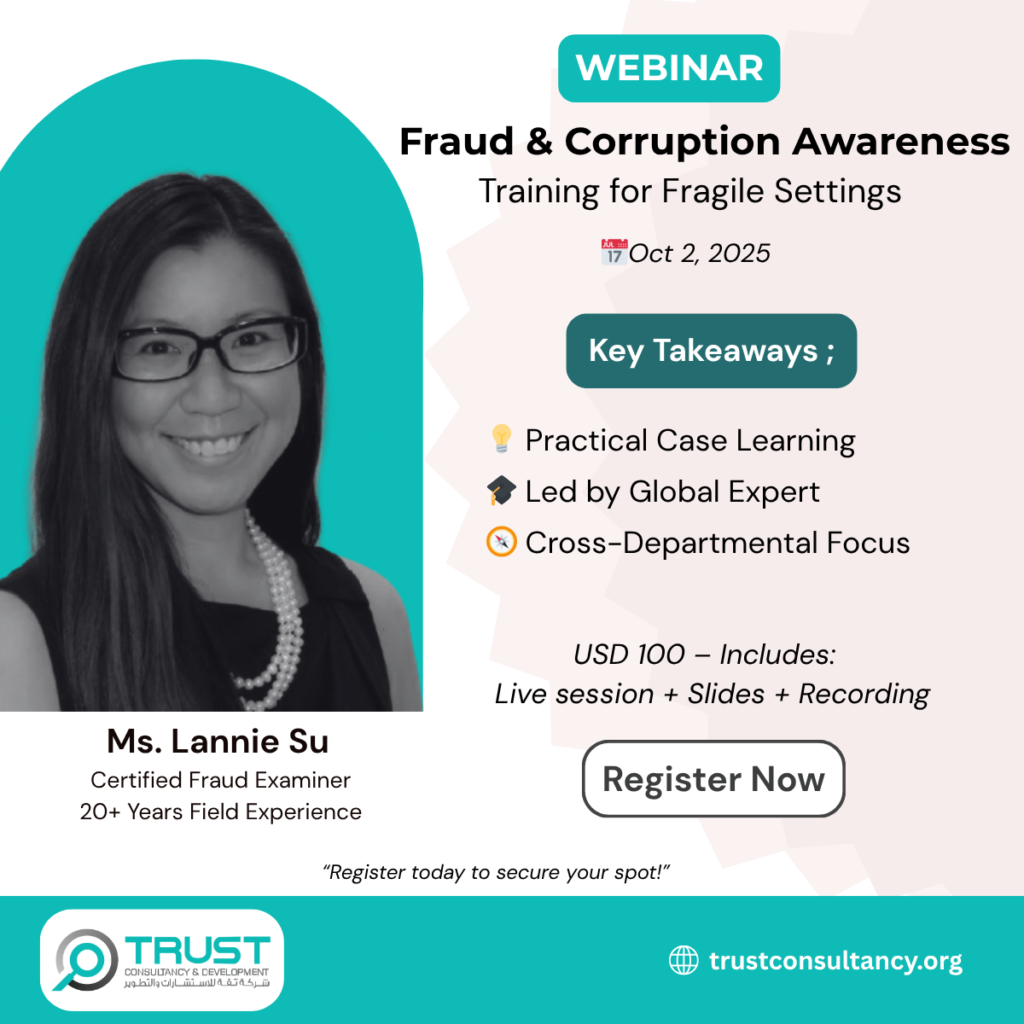
exposure to misconduct. In a recent TRUST seminar, Lannie Su, an independent investigator
and specialist in anti-corruption and fraud in humanitarian aid, examined why these risks are
heightened in fragile contexts and how organizations and individuals can respond.
Fragile contexts and risk factorsFragile contexts often involve weak or overstretched institutions that are not equipped to
manage sudden influxes of humanitarian funding. Emergency procurement procedures may
be introduced to enable rapid response, sometimes overriding standard controls and
documentation requirements. Humanitarian organizations also face pressure to demonstrate
quick results to donors or the public, which can discourage transparency and reporting. While
these dynamics do not automatically indicate fraud or corruption, they significantly increase
overall risk and demand vigilance.
Impact on humanitarian objectives and human rights
Transparency International data shows that public perception of corruption remains high in
several regions where humanitarian actors operate, including the Middle East and North
Africa. In such settings, corruption can directly undermine humanitarian objectives by
diverting resources away from people in need. Its impact goes beyond financial loss:
corruption can violate fundamental human rights, including access to food, shelter, and
assistance delivered with dignity. Robust procurement policies, financial controls, and ethical leadership are therefore essential.
Fraud, corruption, and abuse of power
Understanding terminology is critical. Fraud involves intentional deception, such as
falsifying documents or creating ghost beneficiaries or staff. Corruption requires the abuse
of entrusted power for personal or organizational gain and may be overt rather than deceptive.
Common manifestations in humanitarian operations include nepotism, favoritism, bid
rigging, acceptance of sub-standard goods, and informal taxation imposed by armed groups
or local power brokers. Abuse of authority is particularly damaging, as it can silence staff and
protect misconduct.
Conflicts of interest
Conflicts of interest represent another widespread but underestimated risk. These arise when
personal interests interfere, or appear to interfere, with professional responsibilities. Conflicts
may be actual, perceived, or potential. While not all conflicts are prohibited, failure to
disclose them can erode trust and compromise decision-making. Organizational policies generally emphasize disclosure as a protective measure, while concealment constitutes a
breach.
Red flags and investigations
Red flags are early warning signs rather than proof of wrongdoing. They may appear in
programme delivery, procurement, financial documentation, or staff behavior. Not all red
flags are financial, and fear or silence can be as telling as numerical inconsistencies.
Investigations within humanitarian organizations are administrative rather than criminal,
aiming to gather evidence, uphold integrity, and safeguard resources. Conducting
investigations in fragile contexts is complex, and safety must always take priority.
Main points addressed in the seminar:
Fragile contexts increase fraud and corruption risks
Corruption undermines humanitarian impact and human rights
Fraud and corruption take multiple operational forms
Conflicts of interest require disclosure
Red flags signal risk, not proof
Abuse of power enables misconduct
Investigations protect organizational integrity
Individual actions help shift organizational culture
Fraud and corruption present persistent risks to humanitarian action, particularly in fragile,
conflict-affected, or climate-vulnerable contexts. These environments are challenging due
to insecurity, political instability, and limited institutional capacity, but they also intensify
exposure to misconduct. In a recent TRUST seminar, Lannie Su, an independent investigator
and specialist in anti-corruption and fraud in humanitarian aid, examined why these risks are
heightened in fragile contexts and how organizations and individuals can respond.
Fragile contexts and risk factorsFragile contexts often involve weak or overstretched institutions that are not equipped to
manage sudden influxes of humanitarian funding. Emergency procurement procedures may
be introduced to enable rapid response, sometimes overriding standard controls and
documentation requirements. Humanitarian organizations also face pressure to demonstrate
quick results to donors or the public, which can discourage transparency and reporting. While
these dynamics do not automatically indicate fraud or corruption, they significantly increase
overall risk and demand vigilance.
Impact on humanitarian objectives and human rights
Transparency International data shows that public perception of corruption remains high in
several regions where humanitarian actors operate, including the Middle East and North
Africa. In such settings, corruption can directly undermine humanitarian objectives by
diverting resources away from people in need. Its impact goes beyond financial loss:
corruption can violate fundamental human rights, including access to food, shelter, and
assistance delivered with dignity. Robust procurement policies, financial controls, and ethical leadership are therefore essential.
Fraud, corruption, and abuse of power
Understanding terminology is critical. Fraud involves intentional deception, such as
falsifying documents or creating ghost beneficiaries or staff. Corruption requires the abuse
of entrusted power for personal or organizational gain and may be overt rather than deceptive.
Common manifestations in humanitarian operations include nepotism, favoritism, bid
rigging, acceptance of sub-standard goods, and informal taxation imposed by armed groups
or local power brokers. Abuse of authority is particularly damaging, as it can silence staff and
protect misconduct.
Conflicts of interest
Conflicts of interest represent another widespread but underestimated risk. These arise when
personal interests interfere, or appear to interfere, with professional responsibilities. Conflicts
may be actual, perceived, or potential. While not all conflicts are prohibited, failure to
disclose them can erode trust and compromise decision-making. Organizational policies generally emphasize disclosure as a protective measure, while concealment constitutes a
breach.
Red flags and investigations
Red flags are early warning signs rather than proof of wrongdoing. They may appear in
programme delivery, procurement, financial documentation, or staff behavior. Not all red
flags are financial, and fear or silence can be as telling as numerical inconsistencies.
Investigations within humanitarian organizations are administrative rather than criminal,
aiming to gather evidence, uphold integrity, and safeguard resources. Conducting
investigations in fragile contexts is complex, and safety must always take priority.
Main points addressed in the seminar:
Fragile contexts increase fraud and corruption risks
Corruption undermines humanitarian impact and human rights
Fraud and corruption take multiple operational forms
Conflicts of interest require disclosure
Red flags signal risk, not proof
Abuse of power enables misconduct
Investigations protect organizational integrity
Individual actions help shift organizational culture
