
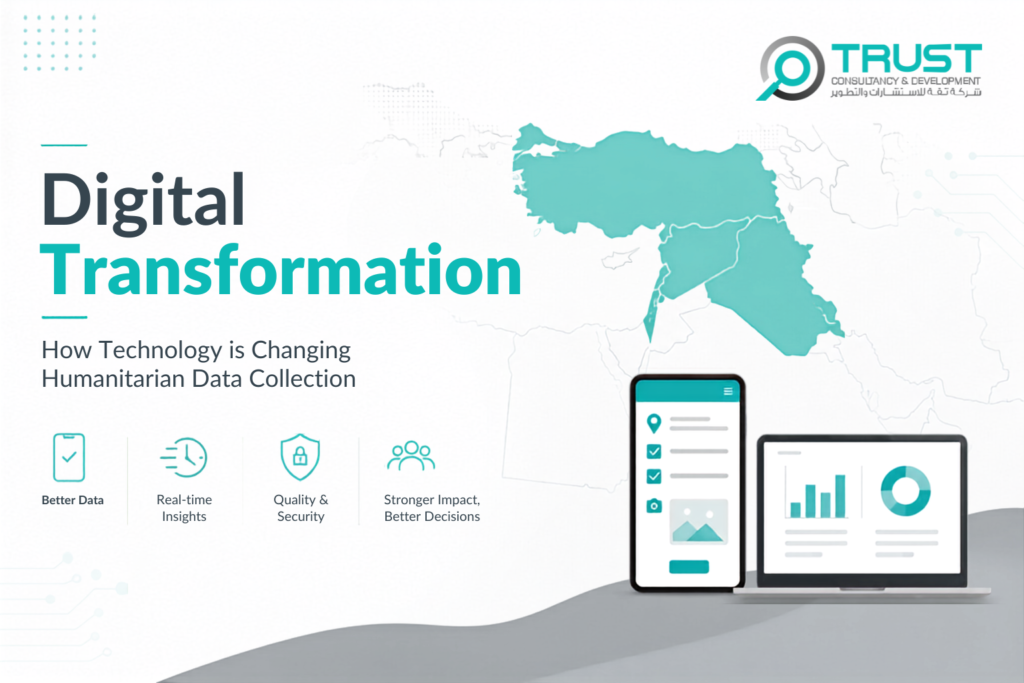
The landscape of data collection in the humanitarian and development sectors is undergoing a fundamental transformation, driven by digital technologies that are reshaping how organizations gather, analyze, and act upon field information. For monitoring and evaluation (M&E) professionals, especially those operating in complex environments like the Middle East and North Africa (MENA), these advances offer unprecedented opportunities to enhance quality, speed, and cost-effectiveness.
Mobile Data Collection: From Paper to Pixels
Mobile technologies have become a cornerstone of modern data collection. Computer-assisted personal interviewing (CAPI) has replaced traditional paper-based methods, significantly improved data quality while reducing fieldwork and processing costs. In the Pacific region, national statistics offices have modernized operations by transitioning from pens to digital tablets, enabling real-time validation and remote updates (SPC, 2024). Mobile phone data (MPD) goes further by leveraging call detail records. Case studies from The Gambia, Ghana, and Côte d’Ivoire show that MPD generates statistics that are timelier, more spatially granular, and far cheaper than traditional surveys (World Bank, 2026a).
Data Collection Platforms
Beyond mobile devices themselves, specialized digital data collection platforms have transformed how humanitarian organizations collect and manage field information. Solutions such as Kobo Toolbox, alongside other digital survey platforms, enable enumerators to collect data offline, apply automated validation rules, capture GPS coordinates and photographs, and securely synchronize information once internet connectivity is restored. These capabilities reduce manual errors, improve data quality, and provide project teams with near real-time access to field information, enabling faster operational and strategic decision-making.
Organizations working in monitoring and evaluation, third-party monitoring, research, and assessments including Trust Consultancy & Development have increasingly integrated digital data collection platforms into their field operations to strengthen data quality, improve efficiency, and support evidence-based humanitarian programming in complex environments.
Artificial Intelligence and Remote Sensing
AI is accelerating this shift. In Bangladesh, a pilot using phone metadata and machine learning to identify low-income households outperformed traditional poverty targeting methods, achieving greater accuracy at lower cost (GiveDirectly, 2025). AI-powered tools now integrate satellite imagery with advanced analytics to generate high-resolution population density maps, addressing connectivity gaps that traditional methods miss. The World Bank’s AI for Data program combines statistical methods and frontier AI models to detect anomalies in development data, while FAO’s Data Lab uses natural language processing to extract insights from unstructured sources like news and social media (World Bank, 2026b; FAO, 2025). In the MENA context, such tools are being deployed to monitor agricultural drought in Morocco and assess infrastructure damage in post-conflict Libya.
Navigating Challenges
Despite these advances, adoption requires addressing persistent challenges. Institutional and regulatory frameworks must ensure data privacy, security, and ethical governance. In sub-Saharan Africa, an estimated 57% of organizations lack adequate data protection frameworks; similar gaps exist across parts of MENA, particularly in fragile states (World Bank, 2025). The digital divide remains a concern, as phone surveys risk underrepresenting poorer households without connectivity. In Yemen and Syria, for instance, network outages and low smartphone penetration still limit coverage. Ethical data futures, as piloted by feminist data collectives in Tanzania, offer models that can be adapted for MENA’s diverse cultural and legal contexts (Data4SDGs, 2025).
MENA Region in Focus
In the MENA region, digital transformation addresses distinct challenges including conflict-affected populations, forced displacement, and hard-to-reach areas. Consider Syria, where over a decade of conflict has destroyed traditional statistical infrastructure. Humanitarian agencies now rely on remote sensing and very small aperture terminal (VSAT) connectivity combined with offline-capable mobile apps to reach internally displaced populations in besieged areas like Idlib and eastern Ghouta. These digital methods allow for real-time food security and shelter assessments without exposing enumerators to active conflict zones (Dette & Steets, 2016). In Turkey, which hosts the world’s largest refugee population, mobile-based surveys and call detail record analysis have been piloted to map refugee livelihoods, access to healthcare, and child vaccination rates. These tools help overcome language barriers and mobility restrictions while respecting data privacy regulations (Rhoads et al., 2020).
In Palestine, movement restrictions and checkpoint regimes make traditional household surveys logistically challenging. Development partners have increasingly explored the use of AI-assisted satellite imagery and mobile phone data to assess infrastructure damage following periods of escalation, monitor agricultural activity, and support broader humanitarian analysis. Hybrid approaches combining encrypted mobile data collection with community-based validation have strengthened organizations’ ability to reach communities in Area C and East Jerusalem while maintaining data quality, accountability, and ethical standards (International Journal of Digital Earth, 2024; Palestine Polytechnic University, 2025).
The Path Forward
For organizations committed to effective M&E, digital transformation is no longer optional; it is becoming an essential component of humanitarian and development practice. By strategically integrating digital technologies, organizations can make data more timely, accessible, and actionable, ultimately supporting better decisions and more effective program
However, technology alone is not the solution. Its success depends on responsible implementation, strong data governance, ethical data management, and meaningful engagement with affected communities. Organizations that successfully balance innovation with accountability will be better positioned to generate credible evidence and deliver greater impact in increasingly complex humanitarian environments.
References
Data4SDGs (2025). Pixels and power: How feminists in Tanzania are building ethical data futures. data4sdgs.org
Dette, R., & Steets, J. (2016). Innovating for Access: The Role of Technology in Monitoring Aid in Highly Insecure Environments. Global Public Policy Institute (GPPi).
FAO (2025). Data innovation in action. fao.org
GiveDirectly (2025). In Bangladesh, AI targeted aid faster, cheaper, and often more accurately than manual methods. givedirectly.org
International Journal of Digital Earth (2024). Satellite and AI monitoring of humanitarian crises in the Gaza Strip during the early stage of the Israeli–Palestinian conflict. International Journal of Digital Earth, 17(1).
Palestine Polytechnic University (2025). GeoAI for Mapping Destruction by War in Gaza Strip. Engineering for Palestine Conference (ENG4PAL).
Rhoads, D., Serrano, I., Borge-Holthoefer, J., & Solé-Ribalta, A. (2020). Measuring and mitigating behavioural segregation using Call Detail Records. EPJ Data Science, 9(5).
SPC (2024). Pencils to pixels: Pacific statistics ‘smarter, faster’ with SPC–World Bank tech and training. sdd.spc.int
World Bank (2025). Real-time welfare monitoring in action: Lessons from the ground. blogs.worldbank.org
World Bank (2026a). From pilots to policy: scaling mobile phone data for statistics in West Africa. blogs.worldbank.org
World Bank (2026b). AI for Data – Data for AI. worldbank.github.io
