
What if the biggest gains from AI in a third-party monitoring organization are not only in the field, but also inside the organization that delivers the work?
The assignment ended six months ago. The report was delivered. The client was satisfied. The field team moved on to the next project. Somewhere in a shared drive, there is a folder with country notes, verification checklists, lessons learned, and field reflections that nobody in humanitarian monitoring has opened since. When the next team deploys to the same region, they often start from zero.
This is not just a knowledge management problem. It is one of the quietest, most expensive inefficiencies in a TPM organization, and it is exactly the kind of problem AI and automation can help solve.
In the humanitarian and development sectors, much of the current conversation about artificial intelligence focuses on field-level use cases: remote data collection, translation, transcription, faster analysis, and better reporting. Those applications matter. But for a third-party monitoring organization, there is another equally important question: how can AI and automation strengthen the systems, people, and processes that make reliable monitoring possible in the first place?
At Trust Consultancy and Development, we work in complex, often high-risk environments where quality, speed, and accountability all matter. We are asking where technology can genuinely improve efficiency, preserve institutional knowledge, and strengthen the quality of the services we provide to clients.
AI in Third-party monitoring: a practical shift
The growing discussion around AI in humanitarian monitoring is increasingly moving beyond field operations. That shift is important because TPM organizations do more than collect data. They compete for contracts, manage teams, maintain quality, support clients, preserve knowledge, and ensure that final deliverables are credible, timely, and useful.
In that sense, AI should be seen as an organizational support tool. It can help reduce repetitive work, improve consistency, and create more space for the technical judgment that experienced professionals bring to TPM. But that only works when AI is used deliberately, with human oversight and clear accountability, as reinforced in human review guidance from the ICO and the UN System principles for the ethical use of AI.
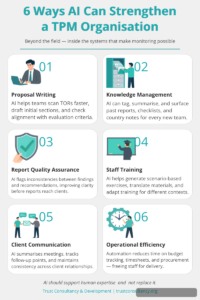
The six areas where AI can strengthen a TPM organization are explored in detail below.
Proposal Writing and Business Development:
For most TPM organizations, proposal development is continuous and compressed into very short timelines. AI can help teams scan TORs faster, draft initial sections, and check alignment with evaluation criteria, giving proposal writers more time for the strategic and contextual thinking that determines whether a bid actually wins. The final proposal must still be shaped by human expertise, but AI can make that expertise more efficient.
Knowledge management and institutional memory:
Institutional memory is one of the most undervalued assets in a TPM organization, and one of the most frequently lost. AI can tag, summarize, and surface past reports, country notes, and lessons learned so that every new team benefits from previous experience rather than starting from scratch. For organizations working across multiple fragile contexts simultaneously, that continuity has direct operational value.
Report Writing and Quality Assurance:
Even well-written TPM reports can suffer from inconsistencies between findings and recommendations or unclear language that reduces a client’s ability to act on the evidence. AI can flag these issues before a report reaches a client, supporting quality assurance at scale. That said, the final review must remain human-led. As the UNHCR AI and ethics guidance and ICO guidance on human review both underline, automation can support judgment, but it cannot replace responsibility. In TPM, where client decisions may rely on the report’s integrity, that distinction is essential.
Staff Training and Capacity Building:
Training field teams is resource-intensive, especially when materials need to be adapted across languages and country contexts. AI can help generate scenario-based exercises, translate content, and produce context-specific examples, reducing preparation time without reducing training quality.
Client Communication and Relationship Management:
Managing multiple client relationships simultaneously is one of the quieter operational challenges in TPM. AI can summarize meetings, track follow-up actions, and help teams maintain consistency across communications, improving responsiveness without replacing the relational judgment that senior staff provides.
Operational Efficiency and Internal Systems:
Budget tracking, timesheets, procurement, and invoice reconciliation all consume time that could be spent on technical work. Automation can reduce that burden, helping small and medium TPM organizations operate with greater agility and discipline.
The limits that still apply
AI can strengthen a TPM organization, but it cannot replace judgment. It cannot fully understand the politics of a context, the dynamics of access, or the relationships that make field work possible. It cannot build trust with communities or interpret subtle signals from the field as a skilled human monitor can.
There are also serious data protection concerns. Sensitive field information, beneficiary data, and client reports should never be uploaded into unsecured systems. Responsible use of AI requires clear rules, secure environments, staff training, and human approval before any client-facing materials are issued. The strongest organizations will be the ones that use AI deliberately, not indiscriminately.
This is why the future of AI in TPM should be framed around support rather than substitution. As PwC’s discussion on responsible AI and third-party risk management highlights, AI can improve efficiency, but it also introduces new risks that must be governed carefully. In TPM, that balance is even more important because the stakes are human, operational, and reputational.
Looking ahead
The future of third-party monitoring will belong to organizations that combine field credibility, digital fluency, and ethical discipline. AI will not replace the relationships, context, and judgment that define strong TPM. But it can help organisations like Trust Consultancy and Development work more efficiently, protect institutional knowledge, improve reporting quality, and strengthen service delivery.
At Trust Consultancy and Development, we see this as a practical evolution, and we continue to think carefully about where AI can add value without compromising trust, privacy, or accountability. The strongest TPM organizations in the years ahead will not be the ones that automate the most. They will be the ones who use technology to make human expertise more effective.
Written by Margaret Auki
References
UNHCR: Artificial intelligence and ethics
PwC: Responsible AI and third-party risk management
IRC: Hyperscience and the IRC Launch Project to Modernize Data Collection and Analysis
INEE / Humanitarian technology resource
UN System: Principles for the Ethical Use of Artificial Intelligence
