
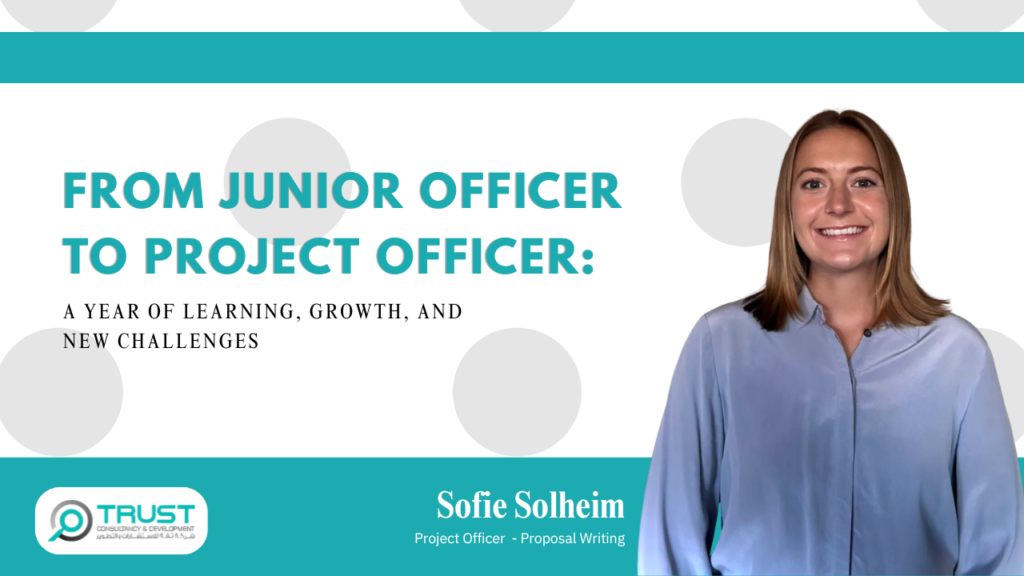
When I joined Trust Consultancy and Development in June 2025 as a Junior Officer in the Proposal Writing (PW) department, I entered a field that was completely new to me. I had no prior experience in Monitoring and Evaluation (M&E), I was eager to learn about the field, understand its role in the development sector, and build new skills.
Those first months were a period of intense learning. I was not only trying to understand the internal workings of Trust, its structure, expectations, and processes; but also learning how proposal writing fits within the broader M&E field. Every task introduced new concepts, terminology, and ways of thinking.
Looking back, that initial learning curve was one of the most valuable parts of my journey.
Building Confidence Through Learning
As a Junior Officer, there was always something new to discover. I gradually became more familiar with the proposal development process and with what was expected of me within the team.
After about five months in the role, I began to feel more confident in handling my responsibilities. I had developed a solid understanding of the core tasks and wanted to continue growing rather than remain within my comfort zone.
At that point, I asked to take on additional and more challenging responsibilities.
Thankfully, my supervisor was incredibly supportive. She guided me through new sections of the proposal process, gave me space to learn, and patiently answered what felt like a billion questions. That support allowed me to gradually take on greater responsibility and ultimately move into the Project Officer position in November 2025.
By June 2026, I had completed a full year at Trust, and I could clearly see how much I had grown both professionally and personally.
The Challenges Behind the Progress
Career progression is exciting, but it also comes with challenges.
One of the biggest adjustments was learning how to manage pressure when multiple proposals were developed within a short timeframe. Proposal writing often involves tight deadlines, coordination across teams, and careful attention to detail. There were periods when the workload became quite intense.
However, those moments also taught me some of the most important lessons:
Prioritization matters.
Not every task has the same urgency, and learning to organize work effectively is essential.
Attention to detail is critical.
Small errors can have significant consequences in proposal development.
Asking questions is a strength, not a weakness.
Many of the skills I developed came from being willing to ask for clarification and guidance.
And perhaps most importantly, I learned that growth often happens during the busiest and most challenging periods.
What Helped Me Grow
Several factors played an important role in my development at Trust.
Supportive mentorship
Having a patient and approachable supervisor made a tremendous difference. I always felt comfortable asking questions, exploring new ideas, and seeking feedback. Her constructive guidance helped me improve while also giving me confidence to take on new responsibilities.
A culture of feedback
During the orientation period and throughout various assignments, feedback was strongly encouraged. We were asked to provide feedback to one another, discuss our work openly, and think critically about how tasks could be improved.
I appreciated that feedback was not treated as criticism, but as a tool for learning. Even as a Junior Officer, I felt that my suggestions and observations were welcomed and respected.
A strong cohort of Junior Officers
One of the highlights of my early months at Trust was joining the firm alongside a group of other Junior Officers. We created a WhatsApp group, supported each other throughout the internship, and collaborated on several group projects. That sense of fellowship made the transition into a new workplace much easier.
Opportunities beyond my comfort zone
Because Trust is a relatively small company, there are opportunities to step into areas that may be unfamiliar.
A great example was when our team needed a Power BI dashboard. Although I had only limited experience with Power BI, I volunteered to take responsibility for the task. Trust gave me the opportunity to lead it, and through that experience I learned a new software and developed skills that I had been wanting to acquire for a long time.
That project became one of the most rewarding experiences of my first year.
The Most Rewarding Moment
Creating the Power BI dashboard stands out as a defining experience in my journey so far.
It challenged me technically, pushed me to learn independently, and allowed me to contribute something tangible to the organization. More importantly, it showed me that I did not need to wait until I felt like an expert before taking on a new challenge.
Sometimes growth begins by simply saying, “I’d like to try”.
Advice for Colleagues Following a Similar Path
If I could give one piece of advice to new colleagues, it would be this:
Key takeaway
Pay attention and stay curious.
Take the time to understand not only what you are doing, but why you are doing it. Ask questions. Seek feedback. Offer yourself up for new tasks, especially those that align with your interests and long-term goals.
Trust is a place where initiative is noticed and where learning opportunities often appear when you are willing to step into unfamiliar territory.
My journey from Junior Officer to Project Officer has taught me that professional growth is rarely a single big leap. More often, it is the result of many small moments: asking a question, volunteering for a task, learning a new tool, accepting feedback, and continuing to challenge yourself even when the outcome is uncertain.
One year ago, I joined Trust with no background in M&E. Today, I look back on that decision as the beginning of a journey that has expanded both my skills and my confidence in ways I could not have imagined.
