Career paths rarely follow a straight line. Looking back, I never imagined that my background in architecture would lead me into the humanitarian and development sector. Yet, that unexpected transition became one of the most rewarding experiences of my professional journey.
When I applied for a Junior Officer position at Trust Consultancy & Development, I knew I was stepping into unfamiliar territory. My academic and professional foundation was in architecture, while humanitarian operations represented an entirely new field. Despite the uncertainty, I was motivated by a desire to contribute to meaningful work that creates positive change in people’s lives. Taking that leap of faith was the beginning of a journey that would reshape both my career and my perspective.
I joined Trust as a Junior Officer in the Capacity Development department, where I quickly discovered that learning extends far beyond formal education. During my first months, I supported a variety of operational activities, conducted research, and developed literature reviews based on international webinars and learning resources. These responsibilities strengthened my analytical and communication skills while introducing me to the broader humanitarian landscape.
What stood out most during this period was the environment at Trust. From the very beginning, I was surrounded by colleagues who were supportive, approachable, and willing to share their knowledge. This culture of collaboration gave me the confidence to adapt, embrace new responsibilities, and develop skills that were entirely different from those I had gained through architecture.
Halfway through my traineeship, I experienced an unexpected transition that would significantly influence my career. I moved from Capacity Development to Proposal Writing, now part of the Business Development department. At first, the shift felt challenging. Entering a new department meant learning unfamiliar processes, adapting to different expectations, and quickly understanding how humanitarian projects are designed before implementation.
However, this transition proved to be one of the most valuable learning experiences of my journey. Working on technical proposals allowed me to see how ideas evolve into structured projects capable of creating meaningful impact. It also gave me a deeper appreciation for the planning, coordination, and collaboration required to design high-quality humanitarian interventions.
During this time, I became particularly interested in Third-Party Monitoring (TPM) and evaluation. I realized that while proposal development lays the foundation for a project, monitoring ensures that those plans translate into accountable, effective, and measurable results. Supporting the TPM team introduced me to an entirely new perspective on humanitarian work, where evidence, accountability, and continuous learning are essential to improving project outcomes.
Working on projects across Syria exposed me to a wide range of sectors, including health, protection, funding, and organizational performance evaluations. Each assignment presented a unique opportunity to expand my knowledge and understand the complexities of humanitarian programming. No two projects were ever the same, which meant there was always something new to learn.
Operating in such a dynamic context also highlighted the importance of adaptability. Humanitarian work requires balancing local realities with international standards while responding to evolving operational challenges. Through each project, I gained a deeper understanding of how careful planning, strong coordination, and effective monitoring contribute to successful implementation. It became increasingly clear that even small operational details can have a significant influence on a project’s overall impact.
Beyond the technical skills I developed, the greatest transformation was personal.
Coming from a different academic background, I initially believed that asking too many questions might reflect a lack of knowledge. Over time, I learned the opposite. At Trust, curiosity is encouraged, and questions are seen as an essential part of professional growth. This mindset changed the way I approached every challenge. Rather than fearing mistakes, I began viewing them as opportunities to learn, improve, and refine my work.
This supportive culture also inspired me to think proactively. I became more confident in sharing ideas, suggesting improvements, and contributing beyond my assigned responsibilities. Knowing that innovation and initiative were valued encouraged me to continue growing both professionally and personally.
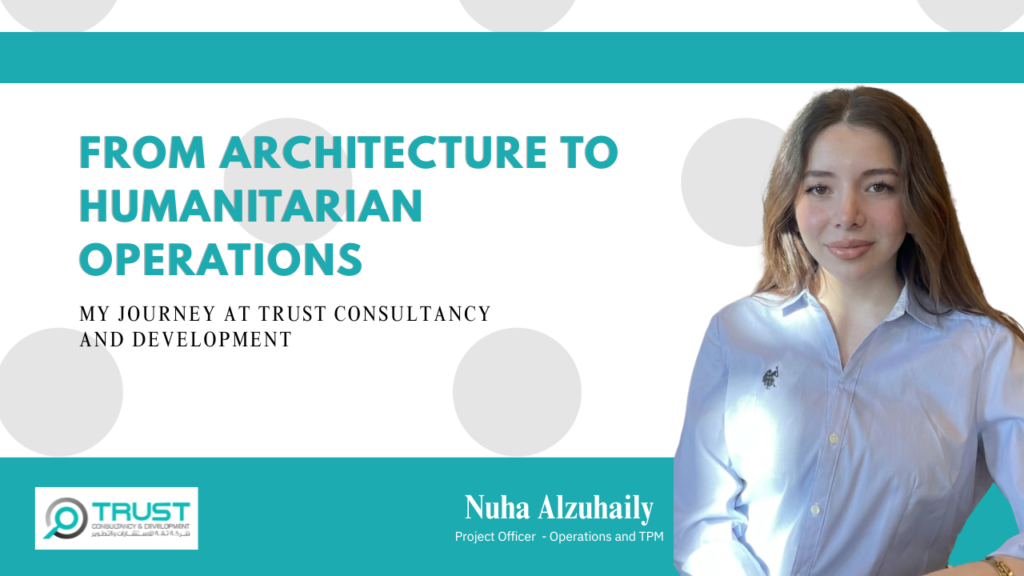
Today, I am proud to serve as a Project Officer in Operations and Third-Party Monitoring. My role has evolved significantly since my first day as a trainee. I now contribute more directly to field operations in Syria, combining data-driven analysis with practical implementation and monitoring activities. Seeing how information collected from the field supports decision-making and strengthens accountability has reinforced my passion for humanitarian operations.
Reflecting on this journey, I realize that my architecture degree was never a limitation; it was simply the starting point of a different path. The analytical thinking, problem-solving, and attention to detail I developed through architecture continue to support my work today, while the experiences I have gained at Trust have broadened my perspective in ways I never anticipated.
If there is one lesson I would share with anyone considering a similar career transition, it is this: never allow your academic background to define your future. Be open to new opportunities, embrace unexpected changes, and never hesitate to ask questions. Growth often begins where certainty ends, and some of the most meaningful opportunities arise when we step beyond our comfort zone.
My journey at Trust Consultancy & Development has been one of continuous learning, resilience, and discovery. It has shown me that meaningful careers are not always planned; they are built through curiosity, adaptability, and a willingness to embrace new challenges. As I continue working in humanitarian operations and Third-Party Monitoring, I look forward to contributing to projects that strengthen accountability, improve implementation, and ultimately create lasting impact for the communities we serve.
