
Introduction
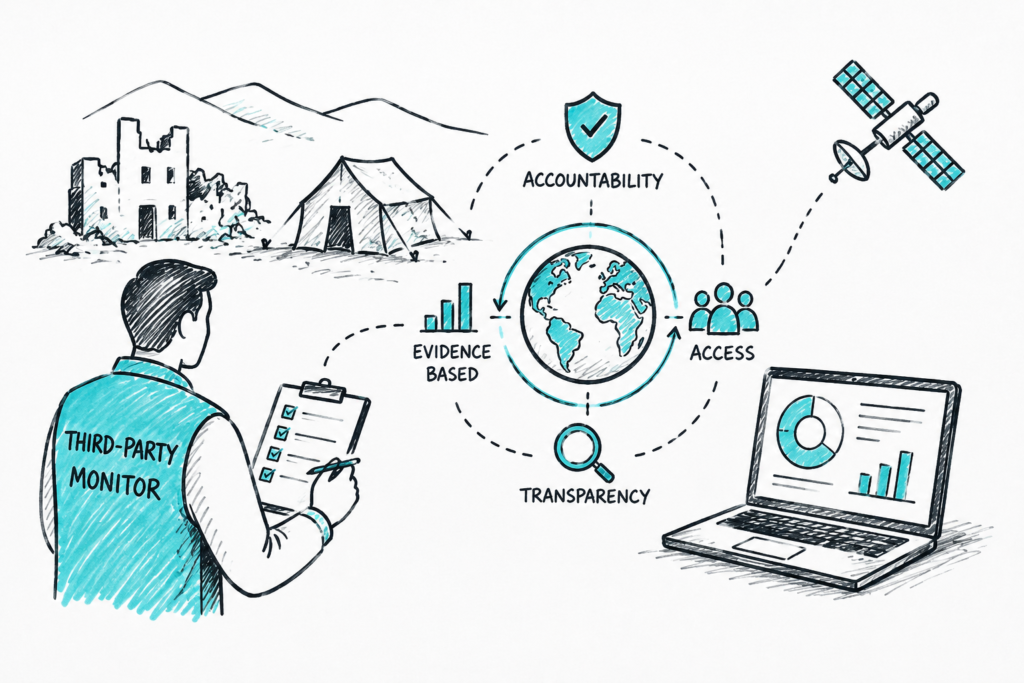
Third party monitoring (TPM) has become an increasingly implemented facet of the humanitarian and development industry over the last fifteen years. Enabling a heightened degree of accountability and access, TPM is the outsourcing of monitoring and evaluation capacities to independent organisations and consultancies, often used in areas of restricted access or limited prior understanding. “While TPM is an important and growing area of data sharing within humanitarian action, it remains an under-researched area of activity”. The comprehension of TPM in high-risk contexts is evidently necessary for the contemporary humanitarian sector; attacks on aid workers, major funding cuts, a rising multipolarity of interests, enhanced calls for accountability, and increasing instability across numerous regions have all put the sector under massive strain and the concept of TPM under heightened scrutiny. In order to understand the efficacy and implementation of TPM in high-risk project areas, this article will assess the benefits and reasoning of outsourcing a project’s Monitoring, the potential pitfalls and obstacles for monitoring consultants, and strategies to mitigate these risks. Ultimately, whilst it presents significant logistical and ethical challenges in high-risk environments, TPM remains an indispensable mechanism for maintaining transparency, optimising implementation methodologies, and ensuring programme efficacy amidst complex humanitarian crises.
Background
As stated, the increasing application of TPM since 2010 is driven by several intersecting factors within the current humanitarian sector. Initial interest in employing TPM came out of an increase in risk to aid workers: “there were 190 attacks on aid workers in 2014, resulting in 121 deaths, three times the 2004 number of 63 incidents”. With this increased risk in mind, international NGOS and donors prefer to use local or international contractors in fragile and conflict-affected (FCV) areas “as the ears and eyes of donors for activities implemented”.
Context
Furthermore, the sweeping cuts in foreign aid budgets from donor governments have increased the pressure on INGOs to reduce expenses, demonstrate value for money, and verify transparent resource allocation. For much of the twenty-first century, France, Germany, the United Kingdom, and the United States contributed approximately 66% of total official development assistance (ODA). 2024, however, marked the first instance since 1995 where all four providers simultaneously reduced their ODA budgets, while projected budget adjustments suggest that 2025 will be the first time all four nations experience a consecutive annual reduction in net ODA. With this in mind, humanitarian funding continues to involve a complex, multi-layered chain of donors and agencies that makes tracking resources highly challenging, especially during emergencies and urgent crises. This convoluted system, combined with a lack of localised control, has led to increased accusations of aid diversion and procurement fraud as beneficiary communities “perceive corruption to be one of the most pressing issues in humanitarian aid”. Additionally, as global politics shifts toward a multipolarity of interests, competing state and non-state actors often attempt to manipulate aid delivery to suit their own strategic goals. Due to these factors, TPM is essential to ensure transparency and restore trust among stakeholders. It guarantees the safety of humanitarian practitioners while securing optimal resource allocation and effective use of funding during periods of reduced international engagement and financial support.
Opportunities
Third-party monitoring “allows agencies to access insecure areas where they are unable to send their own staff“. Furthermore, it can provide an objective and independent view of project performance. By utilising TPM, organisations can gather insights that standard approaches might not achieve. It also helps provide independently verified information, which is particularly useful when agencies engage with a TPM provider to authenticate the information provided by its partners. Additionally, TPM allows organisations to sustain essential communication and information flows with communities while satisfying the accountability and reporting requirements of donors and stakeholders. Additionally, employing third-party monitors serves as a low-visibility approach that decreases security risks for both local communities and the monitors themselves. This provides a safer alternative to highly visible site visits from an agency’s own international personnel, who would otherwise need to rely on hard protection measures to meet organisational security standards. Finally, in specific financial circumstances, TPM can allow more cost-efficient field monitoring when the cost of monitoring through an organisation’s own staff is high.
Threats
Despite the clear benefits, the use of TPM introduces significant logistical and ethical challenges, particularly in high-risk environments. Whilst the previous paragraphs elucidated the security concerns of humanitarian organisations, and the resultant uptick in implementation of TPM, it does not reduce the risk attached to operating in these areas, it simply outsources that risk. Recent data from the Aid Worker Security Database (AWSD) highlights that national aid workers consistently account for the vast majority of casualties, representing 97% of the total 383 aid worker deaths in 2024. Rather than eliminating the threat, remote monitoring arrangements create a system where local actors are left to operate in high-risk environments without the robust security frameworks and resources enjoyed by their international counterparts, thereby seriously putting the ethical argument of implementing TPM into question. Additionally, there is a risk that consultants may feel pressure from local armed groups, authorities, or even the hiring agency to skew the evaluation or present the situation more positively. The Clingendael Institute conducted a study that investigated TPM use in Syria and Somalia reporting high levels of scepticism among some aid workers about the impartiality of TPM services.
Responsibilities
To ensure the reliability and ethical integrity of third-party monitoring, aid organisations and donors should implement robust risk-mitigation strategies. It is essential to conduct comprehensive background checks and capacity assessments of partner organisations to ensure they have the necessary training and independence. On top of this, establishing clear, non-negotiable safety standards and insurance coverage for all third-party field staff is critical.
Conclusion
Whilst TPM presents significant logistical and ethical challenges in high-risk environments, it remains an indispensable mechanism for maintaining transparency, optimising implementation methodologies, and ensuring programme efficacy within complex humanitarian crises. As shown, the basis for TPM is rooted in the contemporary challenges of restricted access, major funding cuts, and a rising multipolarity of interests. While the outsourcing of evaluation creates obstacles such as security risks, potential data bias, and accountability gaps, these can be managed through rigorous vetting and strong safety protocols.
About the Author
Charles Fahie is an IR and politics graduate with a master’s degree in Journalism and a second master’s degree in humanitarianism, aid and conflict. With roughly ten years experience in the Middle East, Charles focuses on political and social research and analysis in the region.
