
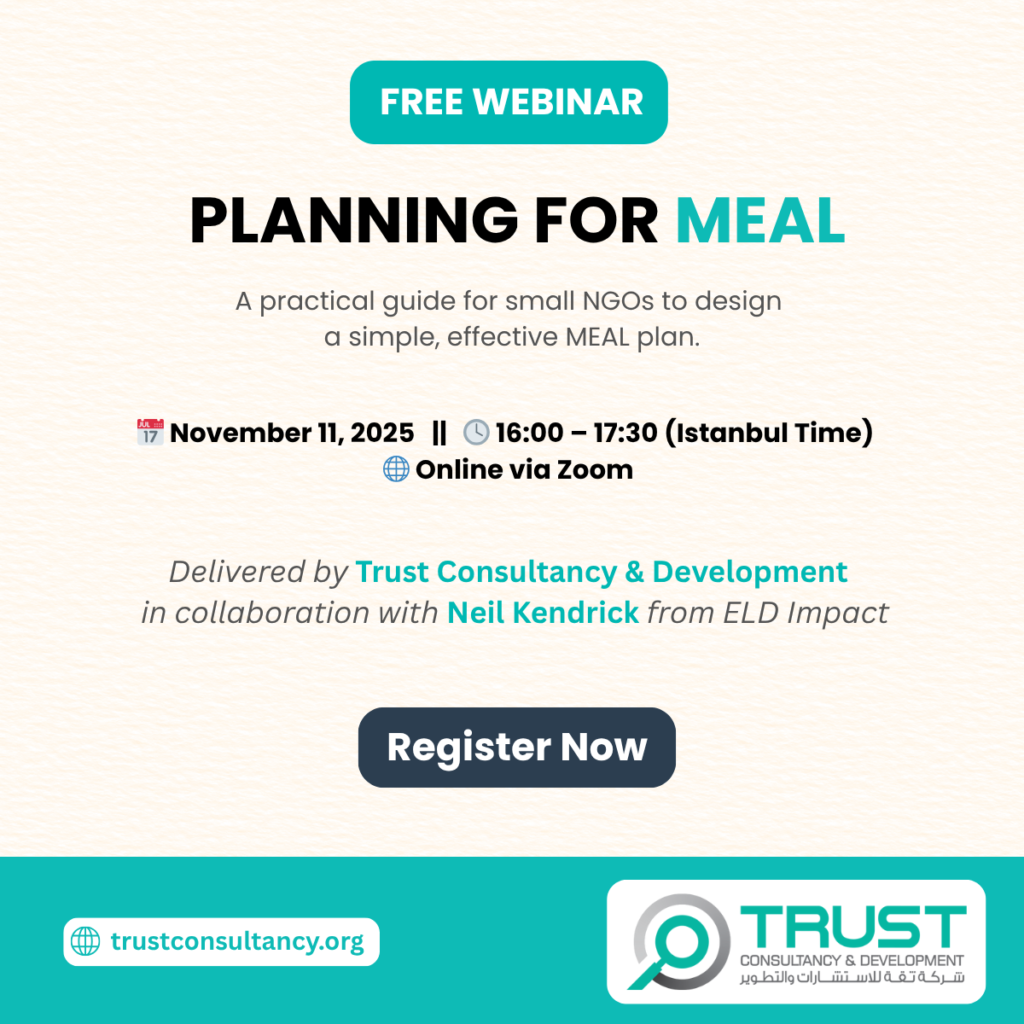
For many small NGOs, Monitoring, Evaluation, Accountability and Learning (MEAL) can feel complex and resource-intensive. A recent webinar led by the founder of ELD Impact, Neil Kendrick, reframed MEAL as a practical, adaptable system designed to help organizations manage projects more effectively and strengthen their impact.
MEAL begins with the right questions
The session opened with a storytelling exercise centered on Sita, a doctor working in rural Nepal to reduce maternal mortality. Through her example, participants were invited to consider the questions humanitarian practitioners face daily: Are activities being implemented as planned? Are they leading to meaningful change? Are communities being heard? And what are we learning along the way?
MEAL helps answer four core questions across a project cycle:
- Monitoring: Are we on the right track? Is implementation happening as planned?
- Evaluation: Did we achieve the change we intended?
- Accountability: Are we listening to communities and communicating transparently?
- Learning: What is working, what is not, and how should we adapt?
Together, these elements form a system that supports decision-making, rather than a standalone reporting requirement.
Linking activities to impact
Using Sita’s project as an example, the webinar illustrated how activities connect to longer-term impact. Community mobilization and training activities aim to strengthen health workers’ skills, leading to increased access to antenatal care and, ultimately, reduced maternal mortality. MEAL helps ensure this pathway is tested and monitored, rather than assumed.
Activities should lead to clear outputs, which in turn contribute to outcomes and impact. MEAL provides the structure to track whether this logic holds true in practice.
Building a realistic MEAL framework
Central to this process is a MEAL framework, often presented as a simple table. For each result, it clarifies:
- What will be measured
- How it will be measured
- When data will be collected
- Who is responsible
- How findings will be reported
Each element plays a role in ensuring data is collected, understood and used. The webinar stressed the importance of realism when setting indicators, targets and data collection frequency. Context, capacity and operational constraints must be considered, and impact expectations should be achievable.
Participants were encouraged to recognize cascade effects, such as the difference between people reached and people actively participating. Honest frameworks measure what is feasible, acknowledge what cannot be measured, and remain transparent about limitations.
Designing indicators that make sense
Several practical principles were shared to guide indicator design:
- Set targets aligned with context and organizational capacity
- Measure both reach and quality, not just numbers
- Match data collection frequency to what is meaningful and feasible
- Use methods appropriate to the audience and setting
- Be explicit about constraints and data gaps
Good MEAL does not require perfect data; it requires credible, useful information that supports decisions.
From data to action: monitoring, accountability and learning
MEAL is most effective when embedded in routine practice. Regular monthly monitoring meetings help teams identify challenges early and adjust implementation before issues escalate. Periodic evaluations then assess whether change is occurring over time.
Accountability was highlighted as a core component. Beyond donor reporting, accountability to staff and communities is essential. Feedback mechanisms reinforce the idea that end users are not passive recipients of aid, but active participants whose perspectives matter.
Learning meetings, when structured and intentional, turn data into insight. Without these spaces, information risks remaining unused. Evidence-based adaptation is a strength, not a weakness.
No one-size-fits-all approach
The webinar concluded by emphasizing that there is no universal MEAL model. Each organization must adapt its approach to its context, resources and objectives. When applied realistically, MEAL strengthens credibility, supports achievable results and provides a clear path forward.
For small NGOs, MEAL does not need to be complex to be effective. When treated as a living system rather than a document, it becomes a powerful tool for learning, accountability and impact.
