
Why MEAL Under Pressure Matters Now
Humanitarian and development organizations are increasingly operating in environments marked by shrinking funding, heightened scrutiny, political constraints, and overlapping crises. In such contexts, decisions must often be made quickly, with incomplete or conflicting information, and under pressure from multiple stakeholders. Yet many MEAL systems remain primarily oriented toward compliance—focused on tracking indicators rather than supporting real-time learning and decision-making.
It is within this reality that the concept of MEAL under pressure becomes particularly relevant. The question is no longer whether programs achieve their predefined targets, but whether MEAL systems are capable of capturing how interventions actually interact with people’s lives—and whether they enable timely, informed adaptation when conditions change.
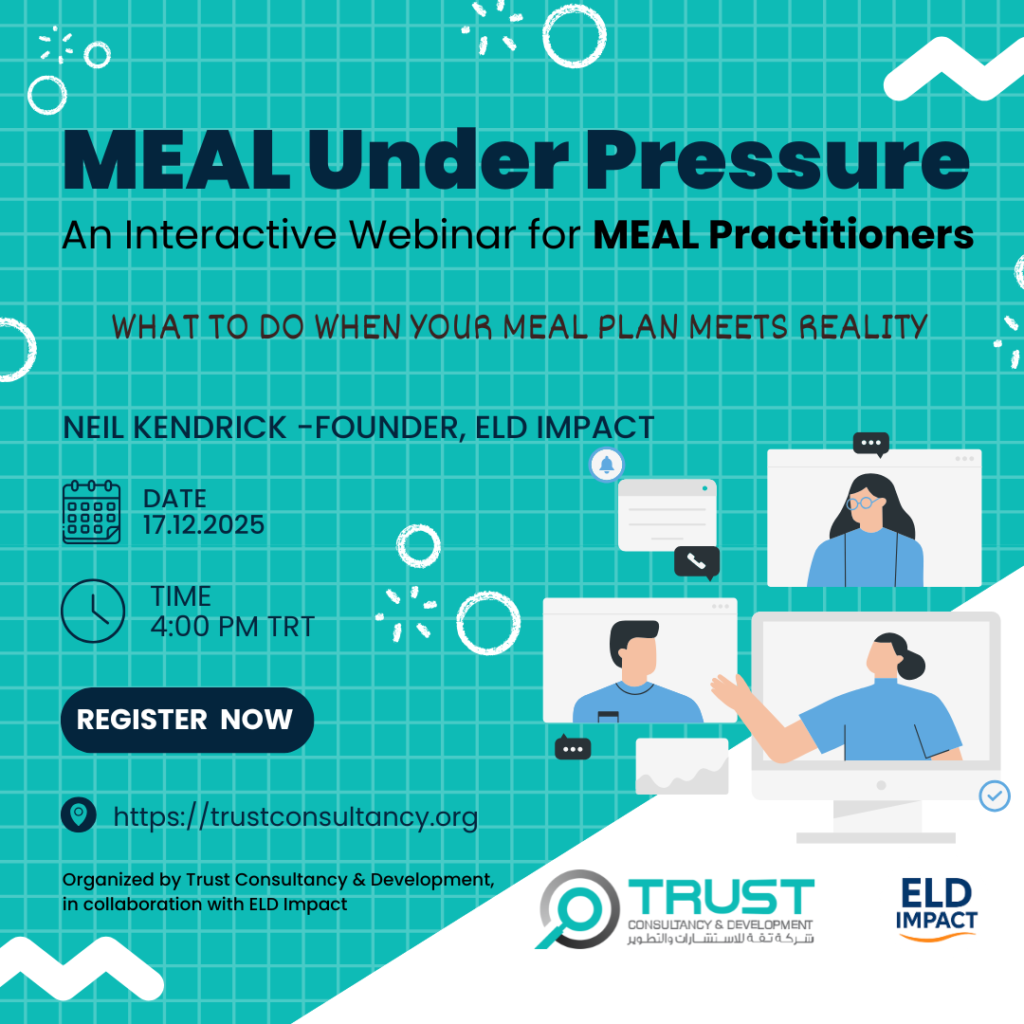
This article builds on insights from the “MEAL Under Pressure” webinar, organized by Trust Consultancy & Development and delivered in collaboration with ELD Impact, which brought together practitioners working across complex and high-risk contexts.
Beyond Indicators: What Traditional MEAL Often Misses
Impact assessment is frequently approached as a technical exercise: define indicators, collect data, and report results. While necessary, this approach often provides only a partial picture. Well-designed MEAL systems can—and should—reveal far more than whether outputs were delivered or outcomes achieved.
During the webinar, participants stepped into the role of MEAL managers overseeing a women’s livelihoods program aimed at improving income and household well-being. On paper, the program appeared successful. Standard indicators showed increased earnings, improved health practices, and strong participation in savings groups. Yet these metrics masked important dynamics unfolding beneath the surface.
A single open-ended question—“What else has changed in your life?”—shifted the analysis entirely. One participant explained that increased income enabled her daughter to attend university, becoming the first in her family to do so. Another described expanding her home to accommodate elderly parents. These outcomes were not captured in the logframe, yet they reflected profound shifts in opportunity, dignity, and family cohesion.
Resonance: Understanding Indirect and Non-Linear Effects
These stories illustrate what can be described as resonance—the indirect, non-linear effects that emerge when interventions interact with existing social, economic, and cultural systems. Resonance can amplify positive impact, but it can also surface risks that remain invisible in quantitative data.
In some households, for example, improved access to electricity enabled nighttime gambling, leading to reduced productivity. Nearly one-third of families reported increased household tension, often linked to disagreements over spending decisions or time allocation. These were not
implementation failures, but signals—indicating where learning and adaptation were needed earlier.
Treating negative or unintended effects as data, rather than problems to be minimized or explained away, is a defining feature of adaptive MEAL.
From Compliance to Decision-Making: Adaptive MEAL in Practice
Some of the most powerful outcomes observed in the scenario emerged through participant-led innovation. Women connected through trust and shared experience began asking practical questions: What if transportation to the market were shared? What if resources were pooled to reduce costs? What if one person sold on behalf of the group?
These discussions led to the formation of a cooperative. Twelve women jointly purchased 200 kilograms of chicken feed, achieving a 15 percent cost reduction through bulk purchasing, alongside additional savings from shared transport. Average incomes among cooperative members increased by 52 percent. Beyond income, the cooperative strengthened social capital, confidence, and collective agency—outcomes that no predefined indicator could have fully anticipated.
These insights emerged because MEAL was treated not as a reporting requirement, but as a continuous learning and decision-support process. Ongoing data review, triangulation across methods, and structured reflection enabled learning to inform action in real time. Importantly, participants also recognized that more frequent reflection could have surfaced risks earlier—highlighting the need for intentional learning moments throughout implementation.
Inclusion as Risk Management
The scenario further underscored the importance of inclusion—not only as an ethical principle, but as a form of risk management. Earlier engagement with husbands and community elders could have anticipated cultural tensions and reduced resistance. Gender-sensitive scheduling might have eased household pressures by aligning activities with women’s availability.
In fragile contexts, exclusion often manifests first as friction, resistance, or unintended harm. Adaptive MEAL systems that actively listen to diverse perspectives are better positioned to identify and address these risks before they escalate.
Listening as a Discipline
Ultimately, impact assessment is not only about whether targets are met. When paired with adaptive MEAL, it becomes a disciplined practice of listening—to intended outcomes, unintended consequences, and the lived realities in between. Resonance is not a side effect of impact; it is central to understanding it.
As humanitarian organizations continue to operate under increasing pressure, the question is no longer whether MEAL systems should adapt, but how deliberately and systematically this adaptation takes place. Moving from compliance to learning is not a technical shift alone—it is a leadership choice.
Trust Consultancy & Development will continue to explore these questions through applied learning events, practice-based research, and collaboration with practitioners seeking to strengthen decision-making and accountability in complex environments
About the Publisher
Trust Consultancy & Development is a consulting and capacity development organization supporting humanitarian and development actors to strengthen systems, learning, and decision-making in complex and high-risk contexts.
FAQs
It refers to designing and using MEAL systems in contexts characterized by uncertainty, limited resources, high risk, and rapid change—where learning and decision-making are as important as accountability.
Traditional MEAL often focuses on predefined indicators and reporting requirements. Adaptive MEAL emphasizes continuous learning, qualitative insights, and the ability to adjust programs based on emerging evidence.
Unintended effects—both positive and negative—reveal how programs interact with real-life contexts. Ignoring them can lead to missed opportunities or unaddressed risks.
· Integrating qualitative methods alongside quantitative indicators
· Creating regular reflection and learning moments
· Using findings to inform real-time decisions
· Ensuring leadership engagement with MEAL insights
Not necessarily. When designed well, adaptive MEAL can streamline data collection by focusing on what truly informs decisions rather than collecting data for compliance alone.
By providing a deeper understanding of outcomes, risks, and context, adaptive MEAL strengthens accountability to communities, donors, and partners.
Adaptive MEAL is particularly relevant for organizations working in:
· Fragile and conflict-affected settings
· Rapidly changing operational contexts
· Programs requiring frequent adaptation and innovation
Trust Consultancy & Development supports organizations through:
· Capacity development and trainings
· Learning events and webinars
· Applied research and advisory support
· Tailored MEAL system design and revie
